
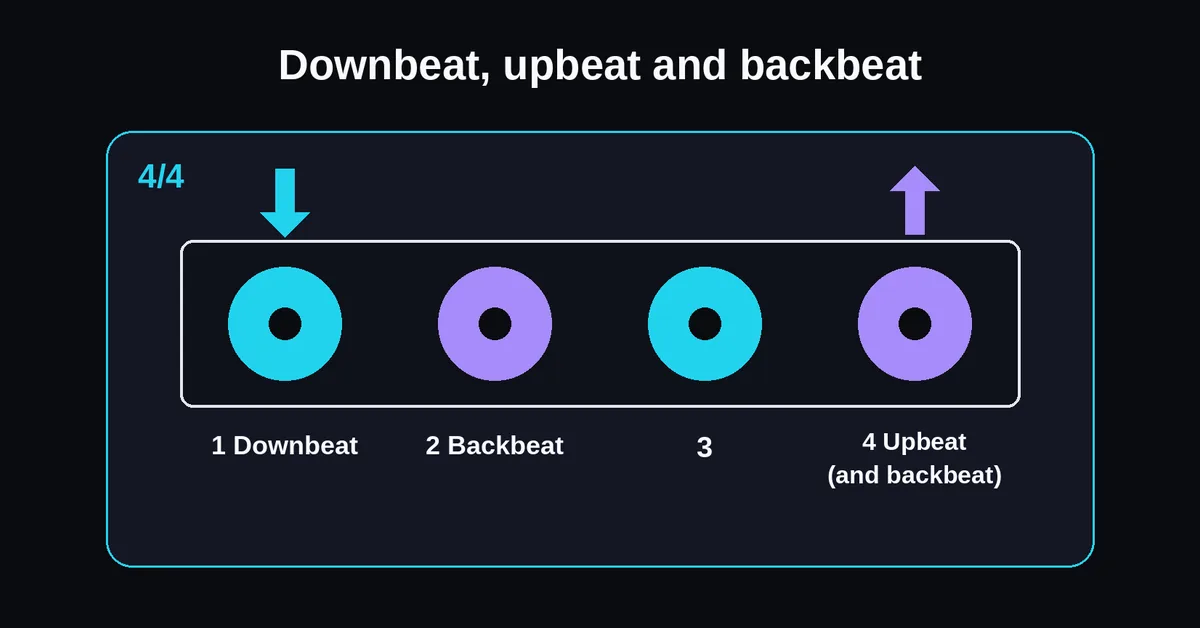
What Is a Downbeat in Music?
Wikipedia's definition is short: number 1 in the bar. In most meters it carries the strongest natural accent, so it acts as an anchor: melodies often begin or land there, harmonies tend to change there, and dancers step there.
The name comes from conducting. A conductor's hand moves down to show beat 1 and up to show the last beat, so the terms downbeat and upbeat follow the direction of the conductor's hand. That gesture is still how an orchestra knows where every bar begins.
The word has a second, everyday use. "Downbeat" also means the first beat of a whole piece or section, as in "the band comes in on the downbeat." In both senses it means the moment the counting starts.
What Is an Upbeat?
The upbeat closes the bar and anticipates what comes next. In 4/4 it is beat 4; in 3/4 it is beat 3. It carries a feeling of lift or preparation, like the breath before a word.
| Meter | Downbeat | Upbeat | Strong beats |
|---|---|---|---|
| 2/4 | Beat 1 | Beat 2 | 1 |
| 3/4 | Beat 1 | Beat 3 | 1 |
| 4/4 | Beat 1 | Beat 4 | 1, and 3 more lightly |
| 6/8 | Beat 1 (eighth 1) | Beat 2 (eighths 4 to 6) | 1, and 4 more lightly |
Be careful with the word in everyday speech. "Upbeat" also means cheerful, and in some genres, especially ska, the guitar chops on the off beats are informally called upbeats. Wikipedia notes that usage. In theory, though, the upbeat is specifically the last beat before a downbeat.
What Are On Beats and Off Beats?
In 4/4, beats 1 and 3 are the on beats, the stronger positions, and beats 2 and 4 are the off beats, the weaker ones. The term off beat is also used for the "ands" between beats. Wikipedia notes that the downbeat can never be the off beat.
| Count in 4/4 | Position | Strength |
|---|---|---|
| 1 | Downbeat, on beat | Strongest |
| 2 | Off beat | Weak |
| 3 | On beat | Second strongest |
| 4 | Off beat, upbeat | Weak, leading to the next bar |
| and (between numbers) | Off beat subdivision | Weakest |
Music that stresses the off beats instead of the on beats sounds syncopated. Rock and roll and ska are two genres Wikipedia names for emphasizing the off beat. For more on how off beat accents create groove, see the syncopation guide.
What Is a Backbeat?
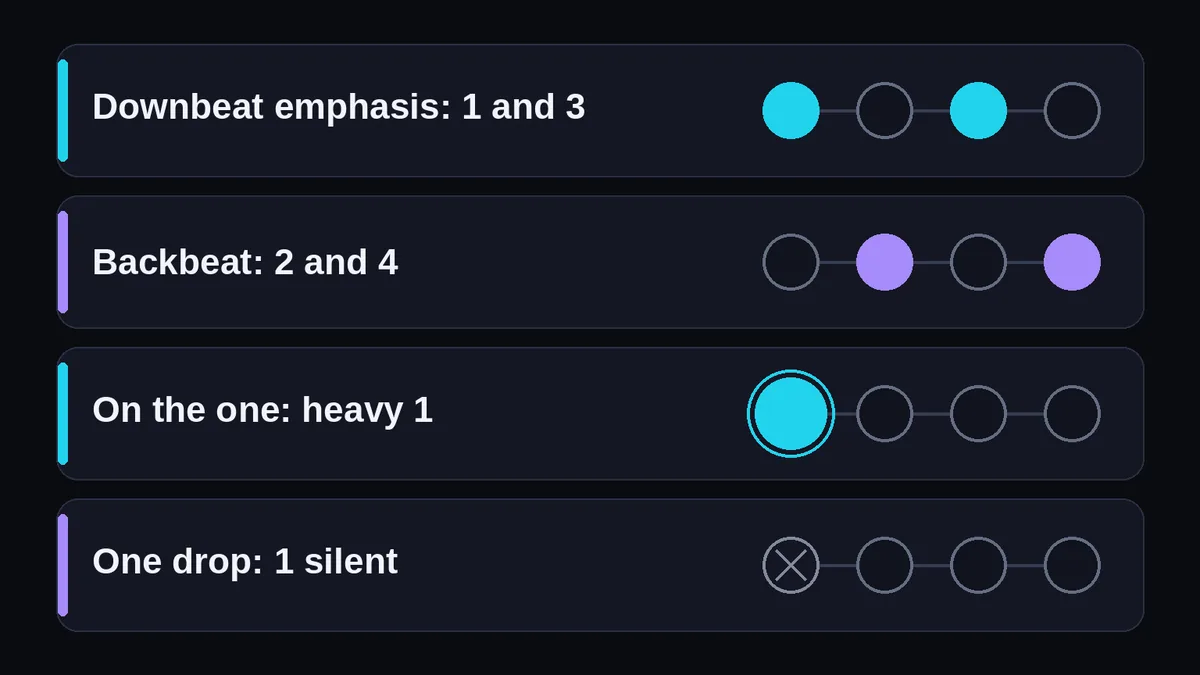
A backbeat is an accent on the off beats of the bar, beats 2 and 4 in 4/4. In modern popular music the snare drum usually plays it, often with hand claps. It gives rock, pop, soul and hip hop their familiar push, the "two and four" that audiences clap along to.
Wikipedia traces strong backbeats through rhythm and blues and early rock and roll recordings, including Wynonie Harris's "Good Rockin' Tonight" from 1948 and Fats Domino's "The Fat Man" from 1949, with drummer Earl Palmer. Variations followed: a doubled backbeat in some early Beatles songs, and a delayed backbeat, landing slightly late, in Booker T. and the M.G.'s "Green Onions."
| Pattern | Where the accent falls | Feel |
|---|---|---|
| Downbeat emphasis | Beats 1 and 3 | Marching, polka, much folk music |
| Backbeat | Beats 2 and 4 | Rock, pop, soul, hip hop |
| On the one | Heavy beat 1 | James Brown's funk |
| One drop | Beat 1 left silent | Reggae |
The last two rows show how much the choice of beat shapes a style. James Brown's funk famously put the weight "on the one," while reggae's one drop leaves beat 1 empty, both noted by Wikipedia.
How Do Pickup Notes Work?
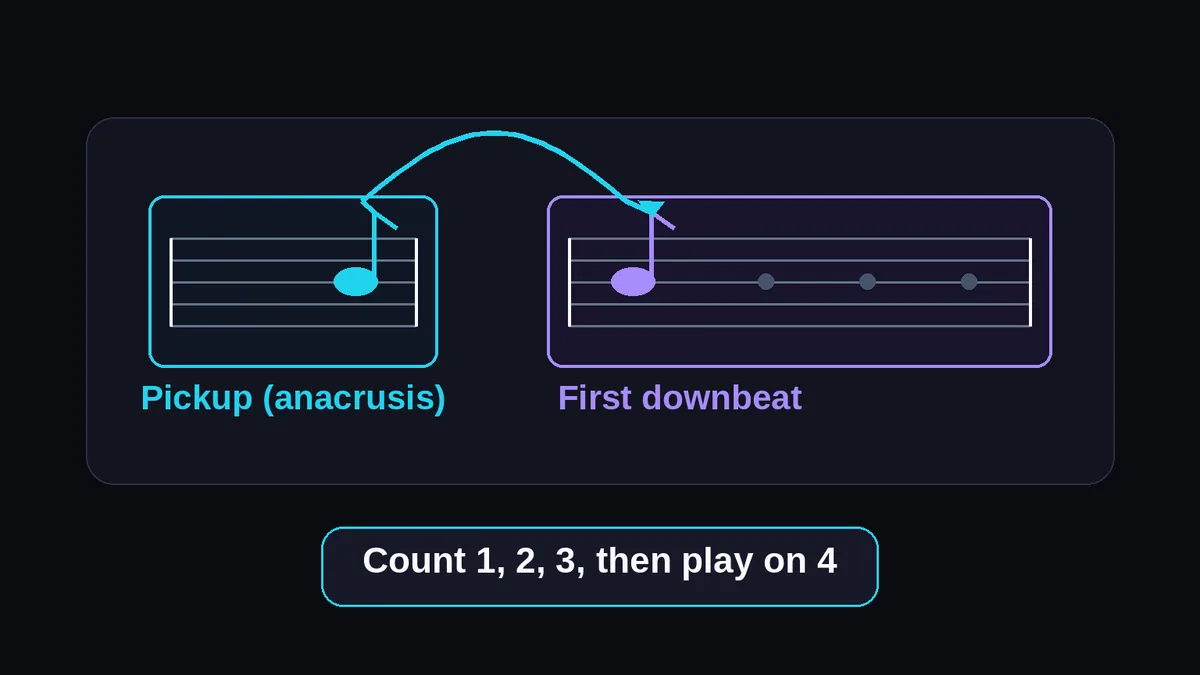
A pickup is one or more notes that come before the first full bar of a piece. It is also called an anacrusis, from the Greek for "up toward the strike." The pickup leads into the first downbeat, so you count the bar before it and start playing partway through.
- Find how many beats the pickup lasts. A single quarter note pickup in 4/4 lasts one beat.
- Count the full bar silently: "1, 2, 3."
- Play the pickup on beat 4, so the next note lands on the downbeat.
- Expect the last bar of the piece to be shortened by the same amount, so the first and last bars add up to one full bar.
Pickups are everywhere in songs and hymns. Many familiar melodies start on a pickup, which is why a song leader often counts in "one, two, three" before the group sings the first word on the downbeat. The 3/4 time signature guide shows the same idea in triple meter.
How Do You Find the Downbeat by Ear?
Listen for the strongest point in the pattern: a bass note, a kick drum, a chord change or a cymbal crash. Count "1, 2, 3, 4" with those events on 1. If chord changes and big drum hits keep landing on your "1," you have found the downbeat.
- Chord changes usually happen on the downbeat, as Wikipedia notes for beat 1.
- In rock and pop, the snare marks beats 2 and 4, so the beat before the first snare hit is usually the downbeat.
- Crash cymbals and new sections usually start on a downbeat.
- In dance music, phrases often run in groups of 4, 8 or 16 bars, and a new phrase starts on a downbeat.
If you are unsure, tap the steady beat on the tap tempo tool first, then count along in fours until the strong events line up with your "1." Getting the downbeat right also helps you avoid half time and double time errors, since a wrong pulse often means a wrong downbeat too.
Why Does the Downbeat Matter for DJs and Producers?
DJs mix on downbeats so that bars and phrases line up: the first beat of one track lands on the first beat of the other. Producers place loops, edits and drops on downbeats so arrangements feel tight. A mix that is on tempo but off by one beat still sounds wrong, because the downbeats clash.
In DAWs such as Ableton Live, Logic Pro and FL Studio, the bar lines in the grid mark downbeats. Checking that a loop starts exactly on a bar line, not one beat early or late, prevents most "it sounds off" problems. DJ software similarly marks the first beat of each bar on the waveform beatgrid. For the mixing side, see how to beatmatch and harmonic mixing.
How Do You Practice Feeling the Downbeat?
Use a metronome with an accented first beat so you always hear where each bar starts, then gradually rely on yourself. The online metronome accents beat 1 in every meter it offers, which makes it easy to lock onto the downbeat.
- Set 4/4 at 80 BPM and say "ONE" loudly on the accent and the other numbers quietly.
- Clap only on beats 2 and 4 for a few bars. That is a backbeat, and it trains you to feel beat 1 without clapping it.
- Switch to 3/4 and say "ONE" on the accent again. Notice the downbeat now comes every three clicks.
- Practice a pickup: count "1, 2, 3" and clap on beat 4, then clap the next downbeat.
- Play along with a recording and call out each downbeat. Check it against chord changes and drum hits.