
What Does a Dot After a Note Mean?
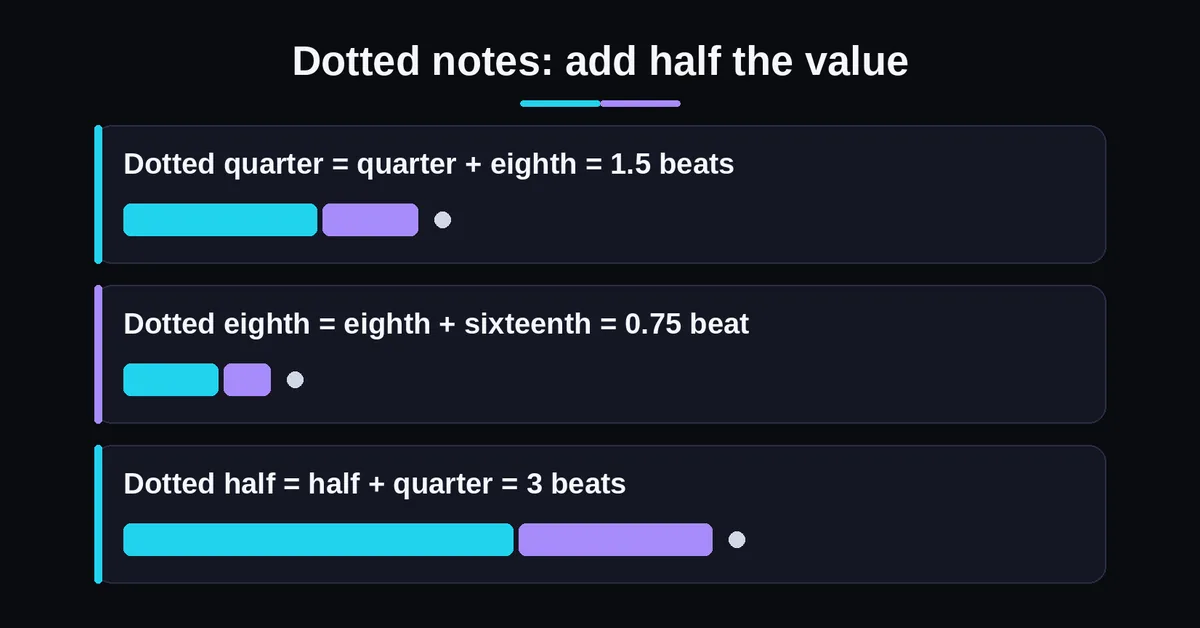
Wikipedia states the modern rule simply: the dot increases the duration of the original note by half of its value. So a dotted note equals the plain note tied to a note half its length. A dotted half note equals a half note tied to a quarter note, three beats in 4/4.
| Dotted note | Equals | Beats in 4/4 |
|---|---|---|
| Dotted half note | Half + quarter | 3 |
| Dotted quarter note | Quarter + eighth | 1.5 |
| Dotted eighth note | Eighth + sixteenth | 0.75 |
| Dotted sixteenth note | Sixteenth + thirty second | 0.375 |
The dot sits to the right of the note head, in a space on the staff. It never crosses a bar line; Wikipedia notes that dots across bar lines are obsolete, and a tie is used instead. For the full ladder of plain note values, see the note values guide.
How Long Is a Dotted Quarter Note?
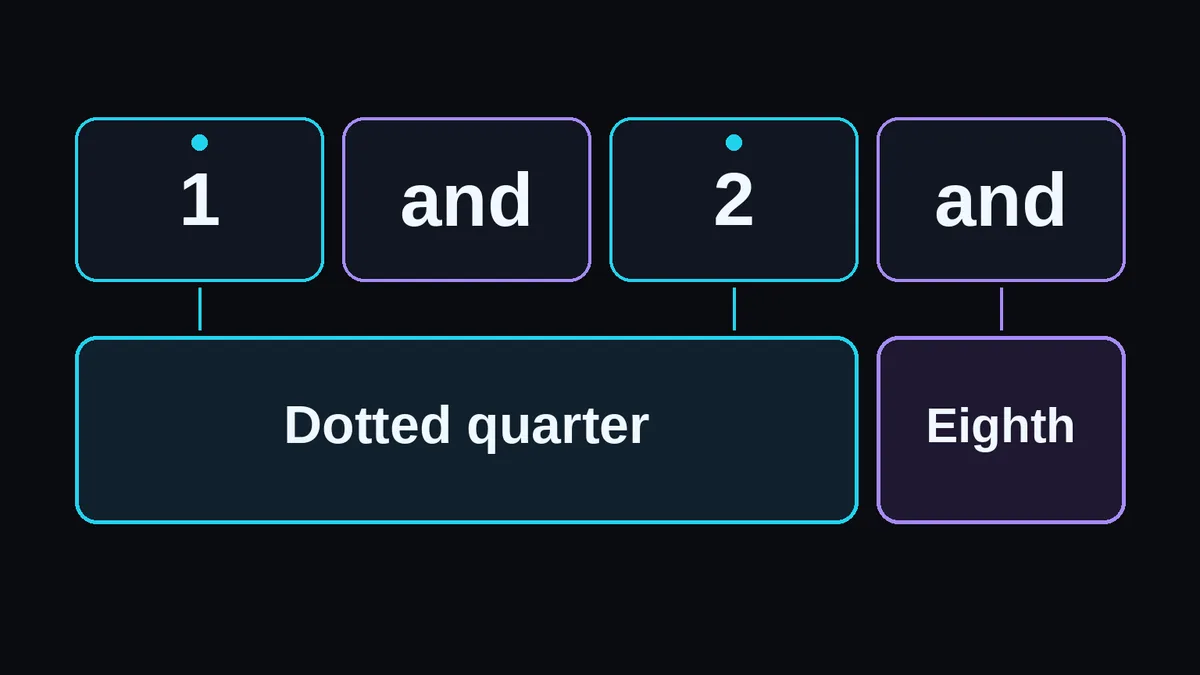
In 4/4, 3/4 and 2/4, a dotted quarter note lasts one and a half beats: one full quarter note plus half of another. It starts on a beat and ends halfway through the next beat, so the following note usually lands on an "and." That off beat landing is what gives dotted quarter rhythms their lift.
A dotted quarter is too long to fit neatly on one beat and too short to fill two. It almost always pairs with an eighth note, which fills the remaining half beat. Together they make two beats: 1.5 + 0.5 = 2. You will see this pair in countless melodies, from folk songs to film themes.
How Do You Count a Dotted Quarter and Eighth Rhythm?
Count in eighth notes: "1 and 2 and." Play the dotted quarter on 1, hold it through "and" and "2," then play the eighth on the "and" of 2. Keep the count steady and the eighth note will land exactly halfway through beat 2.
| Count | 1 | and | 2 | and |
|---|---|---|---|---|
| Dotted quarter + eighth | PLAY | hold | hold | PLAY |
| Same rhythm with a tie | quarter | tied eighth | eighth |
The most common mistake is rushing the eighth note, playing it too soon, so the rhythm sounds like two quarters or like a triplet. Saying "and" out loud on the held part of beat 2 keeps the dotted quarter its full length. Practice with eighth note clicks on the online metronome so every "and" is audible.
There is one spelling rule worth knowing. A dotted quarter that starts on the "and" of beat 1 would hide beat 2 inside a long note, so publishers usually write it as an eighth tied to a quarter instead, keeping beat 2 visible. The sound is the same; only the notation changes.
A useful check: clap the rhythm as a quarter tied to an eighth, then as written. If both sound identical, your dotted quarter is correct.
How Long Is a Dotted Eighth Note?
A dotted eighth note lasts three quarters of a beat in 4/4: an eighth note plus a sixteenth. It usually pairs with a sixteenth note to fill one beat, 0.75 + 0.25 = 1. That pairing produces a sharp, skipping long short rhythm inside a single beat.
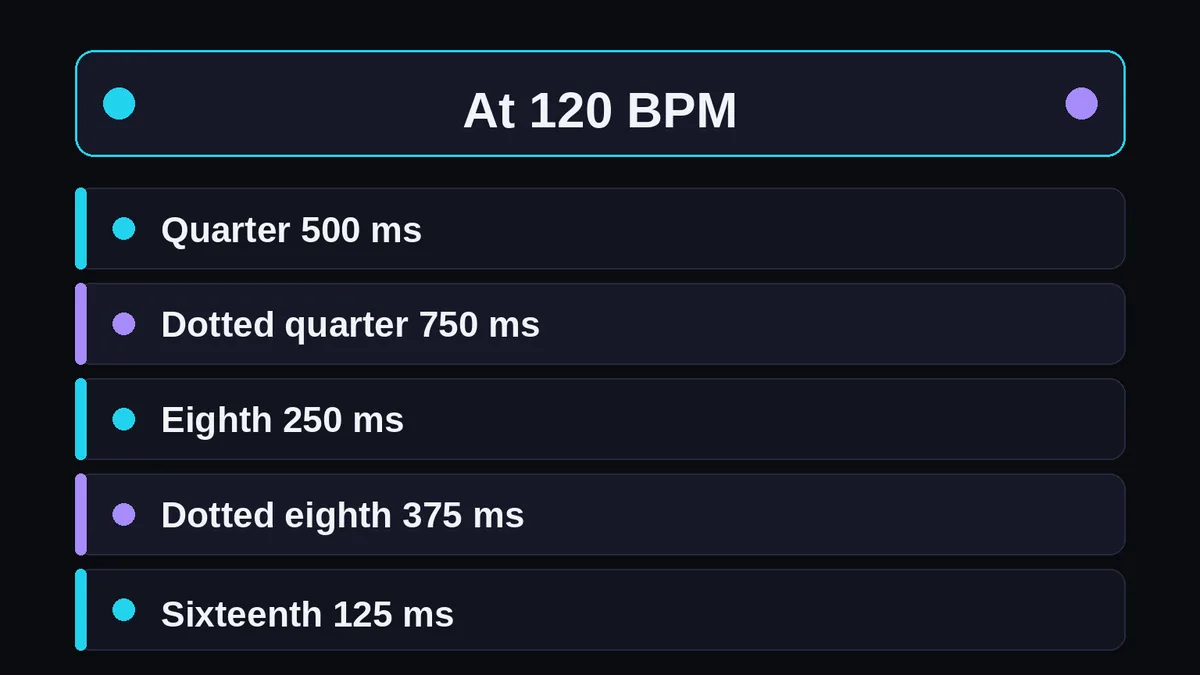
Because it lasts three sixteenths, the dotted eighth also matters outside notation. In music production, a "dotted 1/8" delay repeats every three sixteenth notes, so its echoes fall off the main beat and create a rolling, interlocking pattern with the original part. At 120 BPM, a dotted eighth delay is 375 ms.
How Do You Count a Dotted Eighth and Sixteenth?
Count in sixteenth notes: "1 e and a." Play the dotted eighth on 1 and hold through "e" and "and," then play the sixteenth on "a." The short note lands just before the next beat, which is what makes the rhythm sound snappy.
| Count | 1 | e | and | a |
|---|---|---|---|---|
| Dotted eighth + sixteenth | PLAY | hold | hold | PLAY |
| Reversed: sixteenth + dotted eighth | PLAY | PLAY | hold | hold |
The reversed version, a sixteenth followed by a dotted eighth, is sometimes called a Scotch snap. Both shapes appear constantly in marches, swing era melodies and pop vocals.
Do not confuse a dotted eighth and sixteenth with a swung eighth note pair. A dotted rhythm divides the beat 3:1, while swing is usually closer to 2:1, the feel of a triplet. The swing and groove guide and the triplets guide explain the difference.
How Long Are Dotted Notes at Common Tempos?
Multiply the beat length by 1.5 for a dotted quarter and by 0.75 for a dotted eighth. The table gives values at common tempos, counting quarter notes as the beat. These numbers are handy for setting delays, programming drums or checking a recording.
| Tempo | Quarter note | Dotted quarter | Eighth note | Dotted eighth | Sixteenth note |
|---|---|---|---|---|---|
| 60 BPM | 1,000 ms | 1,500 ms | 500 ms | 750 ms | 250 ms |
| 90 BPM | 666.67 ms | 1,000 ms | 333.33 ms | 500 ms | 166.67 ms |
| 100 BPM | 600 ms | 900 ms | 300 ms | 450 ms | 150 ms |
| 120 BPM | 500 ms | 750 ms | 250 ms | 375 ms | 125 ms |
| 128 BPM | 468.75 ms | 703.13 ms | 234.38 ms | 351.56 ms | 117.19 ms |
| 140 BPM | 428.57 ms | 642.86 ms | 214.29 ms | 321.43 ms | 107.14 ms |
For any other tempo or note value, use the delay calculator or the note duration calculator.
What Are Double Dotted Notes and Dotted Rests?
A second dot adds half of the first dot's value. Wikipedia gives a double dotted note as 1 and 3/4 times its basic value, and a triple dot as 1 and 7/8. Rests can be dotted too, with exactly the same rule.
| Notation | Total length | Example in 4/4 |
|---|---|---|
| Single dot | 1.5 × the note | Dotted quarter = 1.5 beats |
| Double dot | 1.75 × the note | Double dotted quarter = 1.75 beats |
| Triple dot | 1.875 × the note | Rare; Wikipedia cites Wagner, Bruckner and Chopin |
| Dotted rest | 1.5 × the rest | Dotted quarter rest = 1.5 beats of silence |
A double dotted quarter is usually followed by a sixteenth note to complete two beats: 1.75 + 0.25 = 2. Wikipedia also notes that double dots were not used until the mid 18th century, and that in French overtures single dotted notes are often played as if double dotted, an example of how performance style can stretch the written rhythm.
Why Is the Dotted Quarter the Beat in 6/8?
In compound meters such as 6/8, 9/8 and 12/8, each beat is a dotted quarter note, three eighth notes long. So in 6/8 the dotted quarter is not an awkward length at all; it is the normal beat. Two dotted quarters fill a bar of 6/8.
That is why metronome marks in 6/8 often show a dotted quarter. To set a quarter note metronome, multiply by 1.5: a dotted quarter of 60 equals 90 quarter note BPM. In this site's metronome, 6/8 mode counts quarter notes and clicks every eighth note.
Wikipedia notes that dotted rests are conventional in compound meters, where a dotted quarter rest silences a whole beat. For counting and BPM conversion in compound time, see the 6/8 time signature guide and 9/8 time signature guide.