
What Is a Triplet in Music?
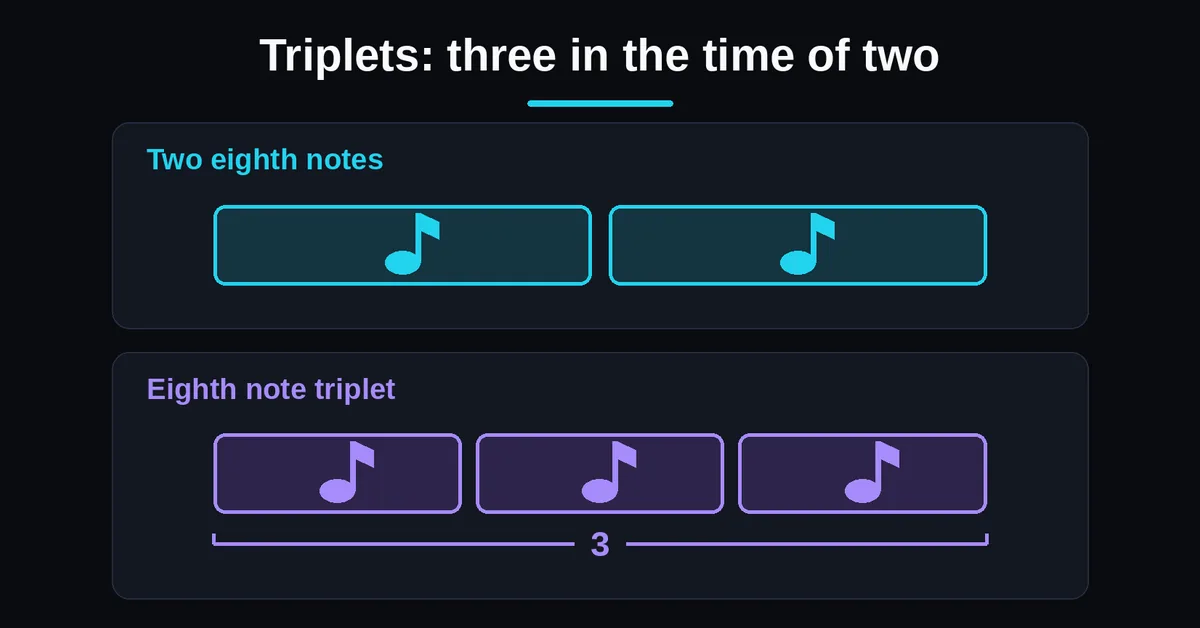
In simple meters such as 2/4, 3/4 and 4/4, each beat normally divides into two equal parts. A triplet breaks that habit by dividing a span into three. Wikipedia describes the triplet as the most common tuplet, the general name for any group that divides time in a way the time signature does not.
The key idea is that a triplet note is shorter than its ordinary namesake. Wikipedia explains it with quarter notes: two quarters normally fill a half note, but three triplet quarter notes take that same time, so each lasts two thirds as long as a normal quarter. The same two thirds rule applies to every triplet value.
That is why triplets feel different from ordinary rhythms. Even at the same tempo, a run of triplets sounds smoother and rounder than a run of straight eighths, because three notes share each beat instead of two.
What Kinds of Triplets Are There?
Triplets are named after the note value inside the group. The most common are eighth note triplets, three in one beat in 4/4. Quarter note triplets stretch three notes across two beats, and sixteenth note triplets squeeze three into half a beat.
| Triplet type | Three notes fill the time of | In 4/4, they span |
|---|---|---|
| Half note triplets | One whole note (two half notes) | A full bar |
| Quarter note triplets | One half note (two quarter notes) | Two beats |
| Eighth note triplets | One quarter note (two eighth notes) | One beat |
| Sixteenth note triplets | One eighth note (two sixteenth notes) | Half a beat |
Eighth note triplets are by far the most frequent. They form the flowing accompaniment in many slow pieces, the shuffle in blues and the rolling feel of countless ballads. Quarter note triplets are less common and harder to place, so they get their own section below.
How Are Triplets Written?
A triplet is shown with the number 3 above or below the group, usually with a bracket or attached to the beam of the notes. Wikipedia notes that older scores sometimes used a slur instead. When triplets continue for a long passage, editors may print the 3 only at the start and then drop it.
Two notation details catch readers out:
- A triplet bracket can hold a rest. A quarter note followed by an eighth under a 3 is still a triplet: the quarter takes two thirds of the beat and the eighth one third.
- Ratios are sometimes written out. Wikipedia notes a less common style, 3:2, meaning three notes in the time of two. You will see this most in modern or complex music.
If the 3 is missing but the beat clearly holds three equal notes in a simple meter, the editor has probably dropped the repeated marking. Check whether the passage began with a marked triplet.
How Do You Count Triplets?
Count eighth note triplets as "1 trip let 2 trip let," with the number on the beat and two syllables after it. Some teachers use "1 la li" or "1 and a" instead. Whatever you say, keep the three syllables exactly even, and keep the numbers landing on the beat.
| Rhythm in one bar of 4/4 | Spoken count | Notes per beat |
|---|---|---|
| Quarter notes | 1, 2, 3, 4 | 1 |
| Eighth notes | 1 and 2 and 3 and 4 and | 2 |
| Eighth note triplets | 1 trip let 2 trip let 3 trip let 4 trip let | 3 |
| Sixteenth notes | 1 e and a 2 e and a 3 e and a 4 e and a | 4 |
The commonest mistake is squeezing triplets into a long short short shape, which sounds like an eighth and two sixteenths. A good test is to alternate one bar of straight eighths and one bar of triplets at the same tempo: only the inside of the beat should change, never the beat itself. The metronome subdivisions guide shows how to hear each grid on the metronome.
How Long Is Each Triplet Note?
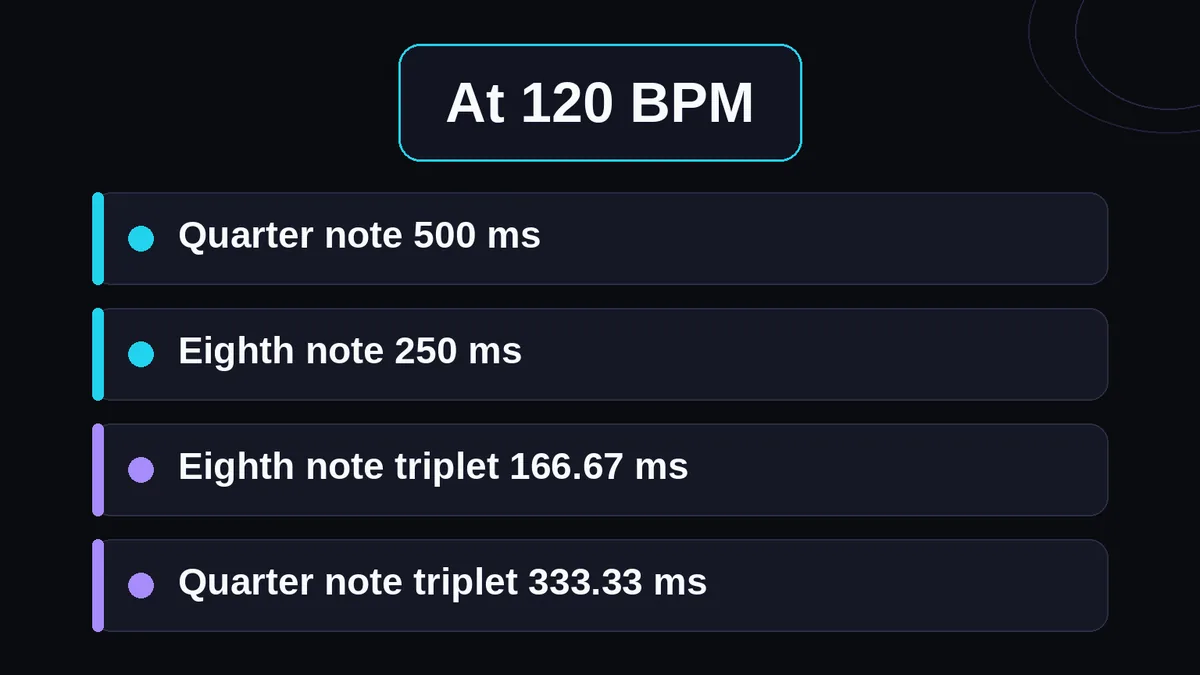
Divide the length of the beat by three. At 120 BPM a quarter note lasts 500 milliseconds, so each eighth note triplet lasts 166.67 ms, compared with 250 ms for an ordinary eighth note. A quarter note triplet lasts 333.33 ms, two thirds of a normal quarter.
| Tempo | Quarter note | Quarter note triplet | Eighth note | Eighth note triplet | Sixteenth note triplet |
|---|---|---|---|---|---|
| 60 BPM | 1,000 ms | 666.67 ms | 500 ms | 333.33 ms | 166.67 ms |
| 90 BPM | 666.67 ms | 444.44 ms | 333.33 ms | 222.22 ms | 111.11 ms |
| 120 BPM | 500 ms | 333.33 ms | 250 ms | 166.67 ms | 83.33 ms |
| 140 BPM | 428.57 ms | 285.71 ms | 214.29 ms | 142.86 ms | 71.43 ms |
These values matter for producers too. Delay times and LFO rates labeled "1/8T" in a DAW are eighth note triplets, so at 120 BPM a 1/8T delay is 166.67 ms. The delay calculator and note duration calculator list triplet values at any tempo.
How Do Quarter Note Triplets Work?
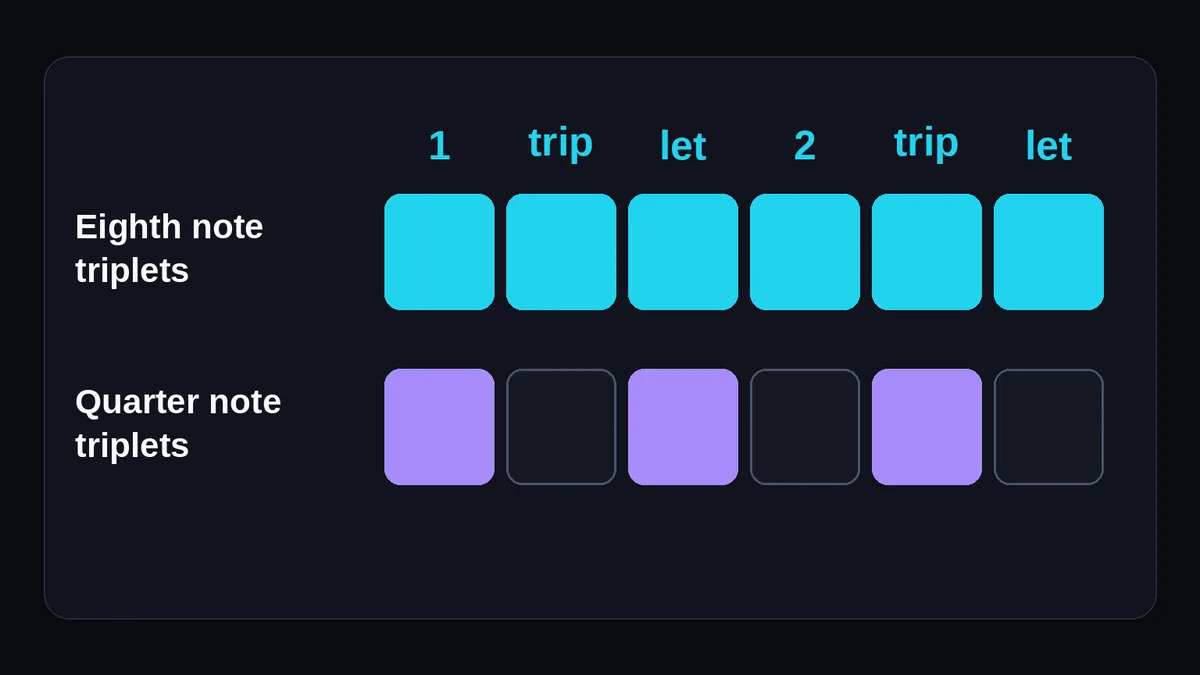
Quarter note triplets place three even notes across two beats. Only the first one lands on a beat; the second falls just before the next beat and the third just after it. The easiest way to feel them is to count eighth note triplets and play every other syllable.
Count two beats of eighth note triplets: "1 trip let 2 trip let." Now play only the first, third and fifth syllables: 1, let, trip. Those three notes are the quarter note triplets.
| Count | 1 | trip | let | 2 | trip | let |
|---|---|---|---|---|---|---|
| Eighth note triplets | X | X | X | X | X | X |
| Quarter note triplets | X | X | X |
Clap this pattern slowly against a steady beat until it stops feeling like it "falls off" the second beat. Quarter note triplets appear often in drum fills, film music and modern rap flows, where the three against two tension adds energy.
How Are Triplets Different From 6/8, 12/8 and Swing?
Triplets temporarily divide beats into three inside a simple meter. Compound meters like 6/8 and 12/8 divide every beat into three by default, so no triplet marking is needed. Swing approximates a long short pattern, often described with triplets but performed more loosely.
| Idea | Beat divides into | Marked with a 3? |
|---|---|---|
| Triplets in 4/4 | Three, temporarily | Yes |
| 12/8 | Three, always | No |
| 6/8 | Three, always | No |
| Swing | Uneven pairs, often near 2:1 | Usually not; written as straight eighths with a swing instruction |
A song full of continuous triplets in 4/4 is often written in 12/8 instead, which is easier to read. The two notations sound the same; the choice depends on whether triplets are the exception or the rule.
What Are Other Tuplets?
Triplets are one member of a family called tuplets. Each tuplet fits a number of notes into a span that normally holds a different number. Wikipedia lists the main ones, including duplets in compound meter and quintuplets and septuplets in more complex music.
| Tuplet | Fits | Common use |
|---|---|---|
| Duplet | 2 in the time of 3 | Two even notes in a 6/8 beat |
| Triplet | 3 in the time of 2 | Everywhere in simple meters |
| Quadruplet | 4 in the time of 3 | Four even notes in a compound beat |
| Quintuplet | 5 in the time of 4 | Fast runs and flourishes |
| Sextuplet | 6 in the time of 4 | Fast arpeggios; grouping can vary |
| Septuplet | 7 in the time of 4 | Virtuoso piano writing |
Wikipedia notes that the sextuplet's grouping is disputed: it can be read as a triplet with each note halved, or as two triplets back to back. Look at the beaming and accents in the score to decide.