
What Does 7/8 Mean?
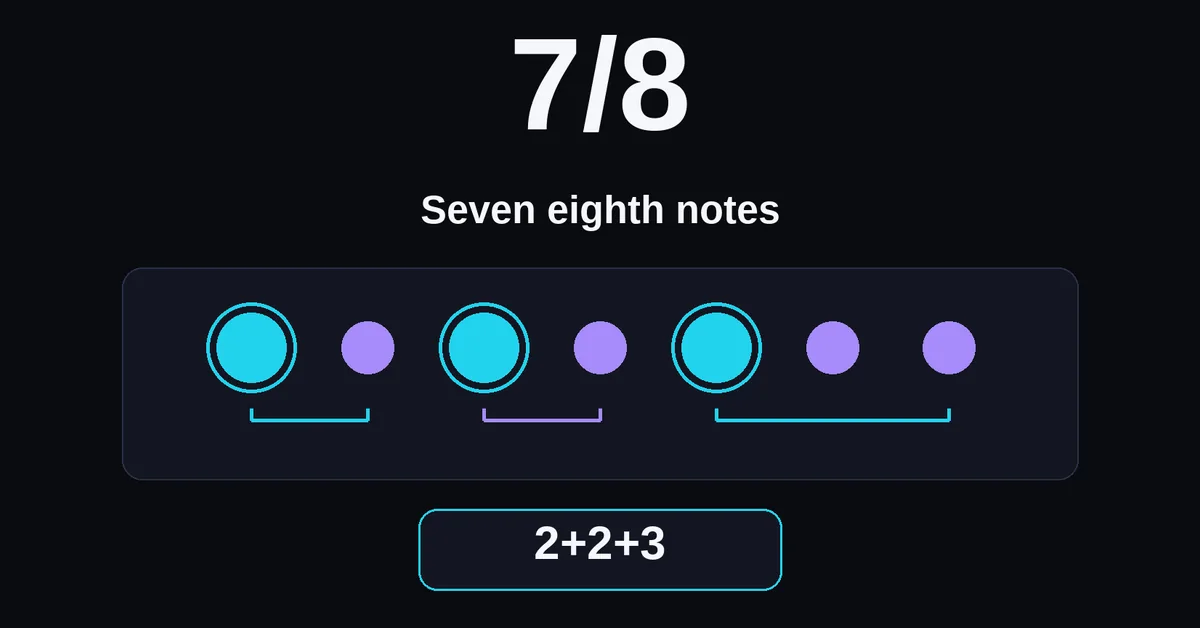
7/8 gives a bar seven eighth note units long. In a grouping made from two short groups and one long group, the short groups contain two eighths and the long group contains three. You can count seven equal pulses while feeling three unequal larger beats, so state which counting level you mean.
Luke Carlson's theory chapter treats 7/8 as asymmetrical meter and lists the three group orders used here. Asymmetric, additive and irregular are common teaching labels, but the score's grouping is more useful for playing than the label alone.
How Do the Three Groupings Work?
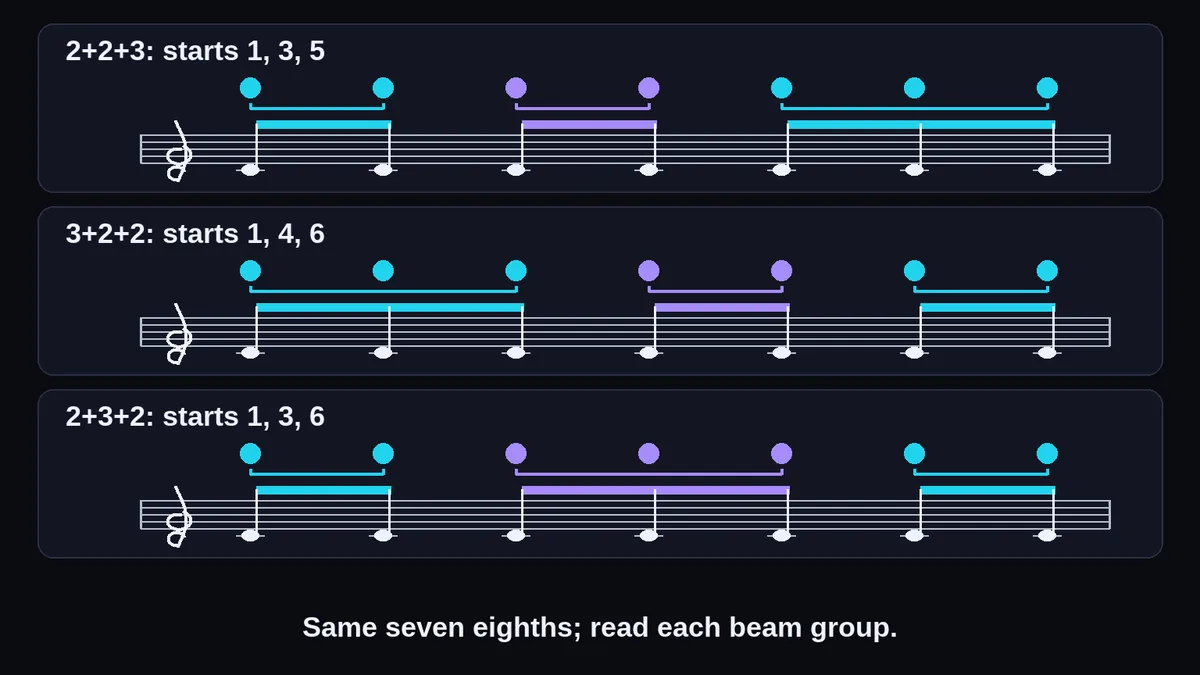
Move the group of three to the beginning, middle or end while leaving all seven eighth note slots in place. Emphasize the start of each group. The bar duration stays the same at a fixed eighth note speed; group starts move to different positions in the seven slot count.
| Grouping | Spoken small groups | Emphasize eighth positions |
|---|---|---|
| 2+2+3 | ONE two, ONE two, ONE two three | 1, 3, 5 |
| 3+2+2 | ONE two three, ONE two, ONE two | 1, 4, 6 |
| 2+3+2 | ONE two, ONE two three, ONE two | 1, 3, 6 |
These accent positions are calculated from the group starts. The group of three can occur in the middle; 2+3+2 is a valid option. Choose the order indicated by the beaming, accents or repeated phrase in the music rather than changing groups at random.
Do not squeeze the long group into the duration of a short one. Its three eighths take one and a half times as long as two eighths. The eighths themselves remain equal. This also means that tapping only the three group starts produces unequal gaps, so those taps cannot represent one steady click rate.
How Do You Find the Grouping in a Riff?
Look for a recurring phrase boundary, then count seven equal eighths between its returns. Test the three grouping orders against the bassline or melody. On a score, check the beams and any written grouping instruction first. A loud note alone is not enough to locate the beginning of every bar.
Open Music Theory's rhythmic techniques chapter explains that beaming or explicit additive signatures can indicate grouping. Write your count beneath the phrase before deciding where to emphasize it.
Original rehearsal example: a guitarist plays seven muted eighths with stronger strokes on positions 1, 3 and 6. Count them as 2+3+2. Ask the bassist to play only those three starts while you maintain all seven eighths. Then restore the melody. If it feels wrong, check where the phrase returns before changing the count.
Which Notes Fill a 7/8 Bar?
Seven eighth notes, fourteen sixteenths, or two quarters plus a dotted quarter all fill one 7/8 bar. The quarter and dotted quarter combination can show any of the three group orders. A longer note may cross those boundaries. Read the beaming as well as checking that the durations add up to seven eighths.
Note value assumption: BPM counts quarter notes. This timing table uses 60 BPM, making an eighth 500 ms. A 7/8 bar has no single dotted quarter beat to convert, so the steady eighth pulse is the unit to count.
| One full 7/8 bar | Eighth note units | Duration at quarter = 60 |
|---|---|---|
| Seven eighth notes | 7 | 3,500 ms |
| Fourteen sixteenth notes | 14 × 0.5 = 7 | 3,500 ms |
| Quarter + quarter + dotted quarter | 2 + 2 + 3 = 7 | 1,000 + 1,000 + 1,500 ms |
| Quarter + dotted quarter + quarter | 2 + 3 + 2 = 7 | 1,000 + 1,500 + 1,000 ms |
| Dotted half + eighth | 6 + 1 = 7 | 3,000 + 500 ms |
The last combination fills the bar without marking the usual internal groups. For more durations, open the note duration calculator.
How Do Rests and Ties Work in 7/8?
A rest occupies time inside the seven eighth slots, and a tie carries a sound across slots without another attack. Neither changes the bar total. Keep counting through silence and sustained notes. In a sparse part, write the missing pulse positions above the staff before attempting the phrase at playing speed.
Open Music Theory's notation lesson explains rest values and ties between notes of the same pitch. Use these original examples:
- In 2+2+3, play a quarter, rest for a quarter, then play a dotted quarter. The total is 2+2+3=7 eighth units; the silence occupies positions 3 and 4.
- Tie the eighth on position 7 to an eighth on position 1 of the next bar. Hold one sound for two eighth durations. The new bar still begins on that tied position 1, even though you do not attack it again.
Do not restart the measure at the next audible note. To find a 7/8 track's tempo by ear, use the guide to counting BPM.
How Do You Set the Metronome for 7/8?
Select 7/8 and enter a quarter note BPM value on this site's online metronome. It clicks each eighth, so an entry of 60 produces 120 eighth clicks per minute. The accent marks only the first eighth of the bar. Speak or clap the remaining group starts yourself to hear your chosen grouping.
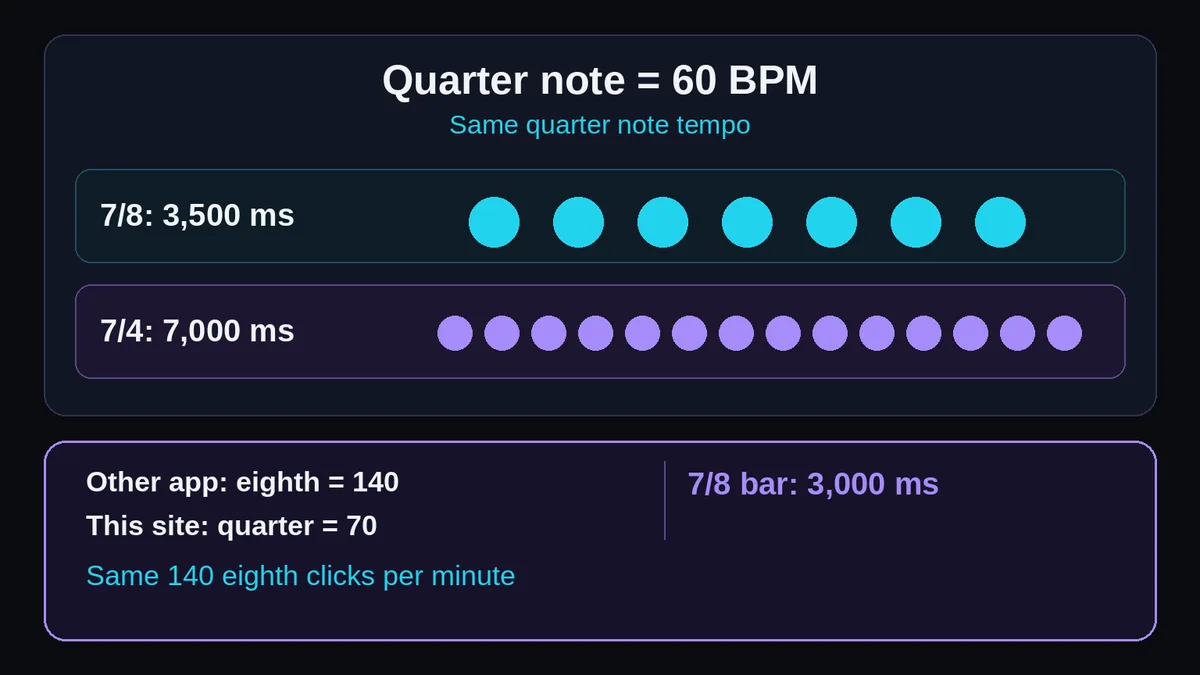
Quarter BPM = desired eighth pulses per minute ÷ 2. For an eighth pulse of 140 per minute, enter 70 BPM. Each eighth lasts about 428.57 ms and the seven eighth bar lasts exactly 3,000 ms before rounding.
To calculate other settings, use eighth duration = 30,000 ÷ quarter BPM in milliseconds, then multiply by 7 for the bar. At 70 BPM, 30,000 ÷ 70 × 7 = 3,000 ms. Four bars last 12 seconds and contain 28 eighth clicks. Calculate from the unrounded duration; multiplying a rounded 428.57 by 7 gives 2,999.99, a rounding artifact.
Another app may display the eighth note rate as its BPM. If its 7/8 setting counts eighths at 140, enter 70 here for the same click spacing. Check the labeled unit before transferring a number. Use time signatures and BPM for beat units and 6/8 versus 3/4 to compare counting levels.
The online metronome supports 7/8 but has no switch for the three grouping patterns. Use its base click setting for the eighth pulse, then add emphasis on positions 1, 3 and 5 for the first exercise. This is a chosen practice speed, not a universal 7/8 tempo.
How Can You Practice Without Losing the Downbeat?
Separate the continuous eighth pulse from the notes you play. Start with the pulse and spoken grouping, add the instrument part, then check whether the next bar arrives on the metronome accent. When something slips, isolate the last group and its return to position 1 rather than repeating the entire passage.
Use this original drum exercise in 2+2+3: play a closed hi hat on all seven eighths, kick on positions 1 and 5, and snare on position 3. The hat supplies seven attacks; kick and snare mark the three group starts. On guitar or piano, substitute low notes for the kick and a chord for the snare.
Clap the group starts while speaking every eighth. Do four bars of 2+2+3, stop, then try 2+3+2 at the same pulse speed. Each bar must still contain seven spoken syllables. If you can count it but cannot play it, remove the pitches and rehearse the rhythm alone.
| What goes wrong | What to check |
|---|---|
| You arrive early on the next accent | Make sure the long group has three complete eighths |
| You arrive late | Check for an extra eighth or a pause at the barline |
| Your part fits, but the band sounds unsettled | Agree on the grouping and count one full bar together before entering |
For a fill, assign each stroke an eighth position before speeding up. A fill occupying positions 5, 6 and 7 in 2+2+3 must finish before the next position 1. Avoid adding a final stroke just because your hands expect an eight note pattern.
How Does 7/8 Differ From 7/4 in Music?
7/8 contains seven eighth note units; 7/4 contains seven quarter note units. At the same quarter note tempo, the 7/4 bar lasts twice as long. In actual music, notation and phrasing affect the felt beat, so a familiar seven count alone does not prove which signature a score or arrangement uses.
At quarter equals 60, the bar lengths are 3,500 ms for 7/8 and 7,000 ms for 7/4. If you change the tempo's note unit, compare that unit before comparing the numbers.
For a listening example, Neil Peart's own account of Tom Sawyer identifies an instrumental section and rideout in 7/8 alongside mainly 4/4 material. Start with the instrumental section. Emily Langerholc's teaching analysis provides another guide to its meter changes. The odd meter survey separates song sections from whole song claims.
Try 5/4 next to practice unequal groups using quarter notes rather than eighths.