
What Does 5/4 Mean?
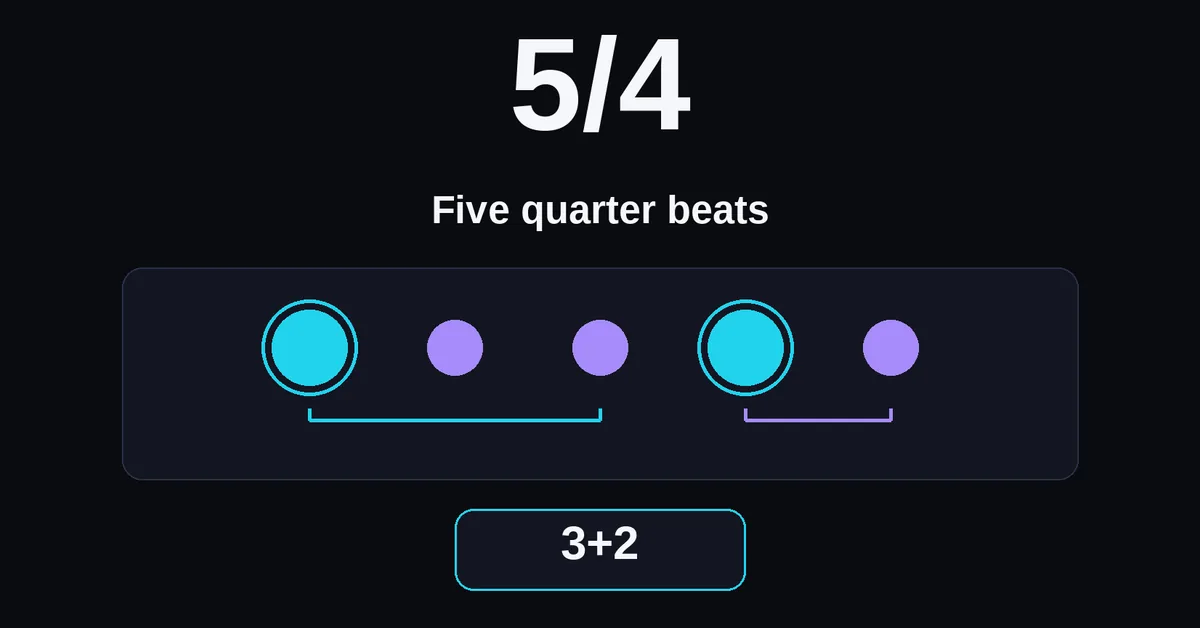
5/4 means that a full bar contains five quarter note beats. Each quarter can divide into two eighths, while the larger bar can group those beats unevenly. Quintuple meter names the five count structure. Odd, irregular and asymmetric are also used in teaching, with terminology depending on whether the discussion concerns subdivisions or larger groupings.
Michigan State University's Rhythm Through Repertoire explains why unequal beat groups need their grouping specified. Follow the accents, beaming and phrasing in the music rather than assuming the time signature gives every detail.
Five quarter beats do not mean a quintuplet. A quintuplet fits five notes into a specified span normally occupied by another division. The time signature defines the bar; a tuplet modifies a division within it.
At a faster tempo, you may feel two larger, unequal pulses instead of saying all five numbers. MSU's quintuple meter chapter describes this distinction: the half note and dotted half can become the felt beats. Keep the quarter notes underneath them steady. Two equally spaced taps would erase the 3+2 or 2+3 relationship.

How Do You Count 3+2 and 2+3?
Count five steady quarter notes and emphasize either beats 1 and 4 for 3+2, or beats 1 and 3 for 2+3. Both patterns last five beats. Only the internal group boundary moves, so changing from one to the other should not change the tempo or delay the next bar's first beat.
| Grouping | Count | Group starts | Durations at quarter = 100 |
|---|---|---|---|
| 3+2 | ONE two three, FOUR five | Beats 1 and 4 | 1,800 ms + 1,200 ms |
| 2+3 | ONE two, THREE four five | Beats 1 and 3 | 1,200 ms + 1,800 ms |
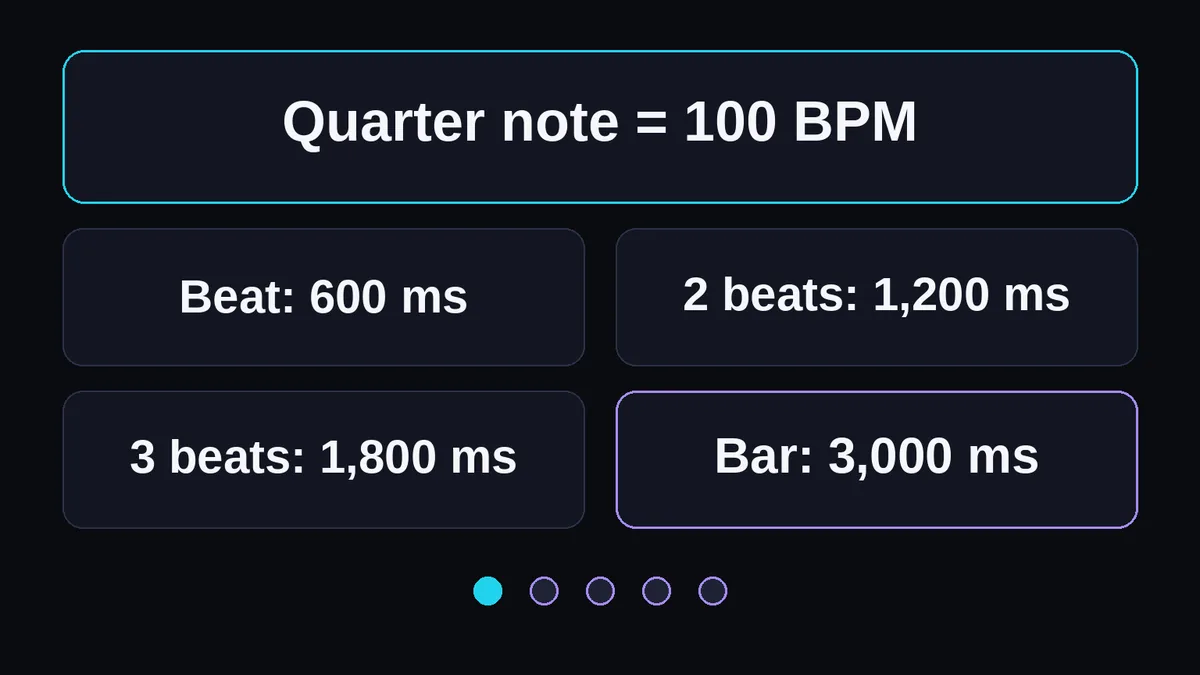
In this timing example, BPM counts quarter notes. Each beat lasts 60,000 ÷ 100 = 600 ms, so either bar lasts 5 × 600 = 3,000 ms.
Original exercise: speak four bars of each grouping. Keep a quiet tap on every quarter and clap only the group starts. Listen for the same five beat bar with its internal weight shifted.
The internal groups have the durations of a 3/4 bar (see how 3/4 differs from 6/8) and a 2/4 bar at the same quarter tempo, but both belong inside one written 5/4 measure.
You can also say "ONE two three, ONE two." That helps you feel the two groups, but both spoken ONEs are not bar starts. When rehearsing with someone else, agree whether "start on one" means the measure's first beat or the beginning of either group. Numbering all five beats avoids that ambiguity.
For even eighth notes, say "1 and 2 and 3 and 4 and 5 and." At quarter = 100, each eighth lasts 300 ms. There are ten syllables per bar; the "and" after 5 still belongs to the current measure. Leave its full duration before returning to 1. To check a 5/4 recording's quarter note rate by ear, see how to count BPM.
A 5/4 bar need not have a strongly marked inner boundary. Original instrument exercise: play C4, D4, E4, F4 and G4 as five quarter notes at equal volume, then repeat with a clear return to C4 on the next bar's beat 1. Compare versions emphasizing beats 1 and 4 or beats 1 and 3; the note durations stay the same.
Which Notes Fit a Bar of 5/4?
Any combination totaling five quarter notes can fill a 5/4 bar. A dotted half plus a half makes a useful 3+2 example, and reversing them shows 2+3. Rests count toward the same total. Note values determine duration, while their placement within the measure determines whether the grouping is easy to read.
Note value assumption: BPM counts quarter notes. The example below uses 100 BPM, so a quarter lasts 600 ms. In compound meters, a dotted quarter mark of 60 would require entering 90 instead.
| One full bar | Quarter note total | Duration at quarter = 100 |
|---|---|---|
| Five quarter notes | 5 | 3,000 ms |
| Ten eighth notes | 10 × 0.5 = 5 | 3,000 ms |
| Dotted half plus half | 3 + 2 = 5 | 3,000 ms |
| Whole plus quarter, duration equivalence only | 4 + 1 = 5 | 3,000 ms |
| Twenty sixteenth notes | 20 × 0.25 = 5 | 3,000 ms |
Use the note duration calculator for another BPM. Whole plus quarter shows the total duration, but hides the 3+2 boundary. To show that boundary, write a dotted half tied to a quarter, followed by another quarter. The tie carries the first sound through beat 4 without a new attack. Carlson explains using ties to preserve beat structure.
Try this original bar: quarter rest, two quarters, half note. Its total is 1 + 1 + 1 + 2 = 5. Count beat 1 silently, attack on 2 and 3, then attack on 4 and hold through 5. The last note occupies two beats even though you play it once. Open Music Theory's rhythmic values lesson explains rest durations and how dots and ties extend notes.
A dotted half plus a quarter is a common arithmetic trap: 3 + 1 = 4, leaving one beat unfilled. Add a quarter rest if the phrase should stop there. Silence completes the bar without adding another attack.
A pickup is a different case. MuseScore's handbook defines it as an incomplete opening measure. For an original one quarter pickup in 5/4, count "5, ONE two three four five." The pickup leads into the first complete bar; do not add four notes just to make that opening fragment full.
Which Songs Use 5/4?
Take Five, the original Mission: Impossible theme and Jethro Tull's Living in the Past provide documented examples of 5/4. Check the version or arrangement you are using. A familiar tune can be rearranged in another meter without changing its title, so follow the linked score or named recording.
| Work | Credit | Verified basis |
|---|---|---|
| Take Five | Paul Desmond; recorded by the Dave Brubeck Quartet | Published score preview in 5/4 |
| Original Mission: Impossible theme | Lalo Schifrin | Schifrin discusses writing in 5/4 |
| Living in the Past | Ian Anderson, Jethro Tull | Anderson's account of writing it |
Desmond composed Take Five; Brubeck's quartet recorded it. The Schifrin interview also distinguishes his theme from the 4/4 version by Adam Clayton and Larry Mullen. A title alone is not enough to establish a recording's meter.
When listening, choose a repeating accompaniment figure and count several returns before deciding where 1 falls. A melody may enter partway through the bar. Keep your count running under it, then test whether the accompaniment returns after five quarters. If you lose the bar, replay a short passage rather than speeding up to catch the next melody note.
What Changes When You Move From 4/4 to 5/4?
At an unchanged quarter note tempo, a 5/4 bar lasts one quarter longer than a 4/4 bar. The click spacing stays the same; the bar line arrives later. In an original exercise alternating these meters, count four quarters, then five, without stretching the final beat of either measure.
At quarter = 100, the 4/4 bar lasts 4 × 600 = 2,400 ms. The following 5/4 bar lasts 3,000 ms, giving 5,400 ms for the pair. Compare the 4/4 guide if you habitually restart after four counts.
Another original rehearsal drill: alternate one 3+2 bar with one 2+3 bar. That pair still contains ten quarters. Moving the group boundary does not require a new time signature. Tell the band "beat 4 in the first bar, beat 3 in the second" so everyone places the internal accents together.
How Can You Practice 5/4 With a Metronome?
Select 5/4 on the online metronome and begin at a chosen quarter note tempo of 80 BPM. It gives five quarter clicks with an accent on beat 1 only. Speak or clap the second group start yourself, using beat 4 for 3+2 or beat 3 for 2+3 as your pattern requires.
At 80 BPM, a quarter lasts 750 ms and the five beat bar lasts 3,750 ms. Play a single note on each group start for four bars, then add a rhythm between them. Keep the bar's first click aligned when you repeat.
For a guitar or piano exercise, hold one chord for the three beat group and another for the two beat group. For drums, keep quarters on one surface and mark the group starts on another. These are original practice patterns, not transcriptions of the songs above.
Record four bars. That is 20 quarters, or 15 seconds at this setting, measured from the first downbeat to the next downbeat after bar four. If your repeat arrives early, isolate "4, 5, 1" and check that you are giving beat 5 its full length. If it arrives late, check for an extra pause before 1.
The online metronome does not move its accent to match the inner grouping. For the wider family of unequal groups, visit odd time signatures.