
What Does Largo Mean in Music?
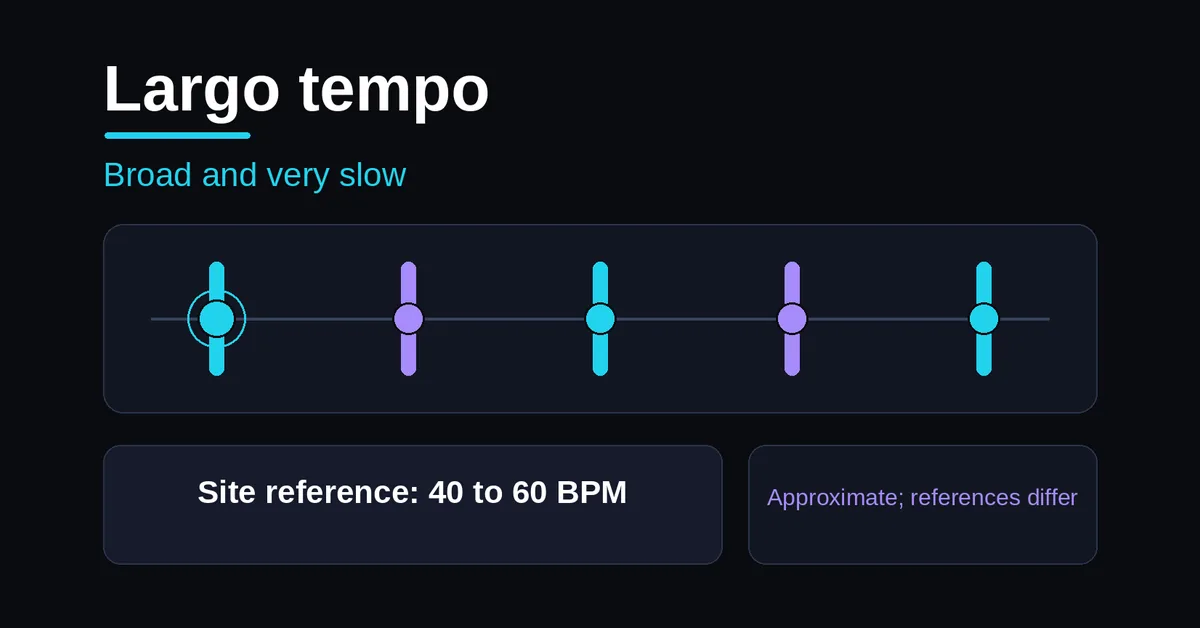
Largo is Italian for broad or wide. In music, it asks for a very slow pace with breadth and dignity, giving sustained notes and long phrases room to unfold. The word describes character alongside speed; the numerical setting alone cannot tell you how to shape a melody. Largo definition.
Play a phrase at 50 BPM, releasing each note early. Repeat with the written durations intact, including notes held across beats. Both passes share a tempo; compare how early releases interrupt the line.
On piano, listen through a held chord before the harmony changes. On violin, plan enough bow for the written duration. Follow the score's articulation and dynamics.
Compare vocal melody, piano writing and sustained strings in the Baroque, Classical and later examples below.
What BPM Is Largo?
This site's Largo BPM reference is 40 to 60, with a midpoint of 50. Other publishers give different boundaries: Symphony Nova Scotia lists 45 to 50 BPM, while Dolmetsch gives 42 to 66 BPM. These are separate reference choices, rather than measurements establishing one compulsory speed for every Largo.
The 50 BPM practice figures count quarter notes, and the external ranges below keep their publishers' own numbers.
| Source | Largo range | What the reference gives |
|---|---|---|
| Symphony Nova Scotia | 45 to 50 BPM | A narrower published band |
| TapTempo markings chart | 40 to 60 BPM | This page's selected reference band |
| Classical-Music.com | 40 to 60 BPM | Examples include Dvořák and Vaughan Williams |
| Arabesque Conservatory | 40 to 60 BPM | Names Handel's “Largo” from Xerxes |
| MuseCool glossary | 40 to 60 BPM | Very slow, broad and stately |
| Music Pandit | 40 to 60 BPM | Places Largo below Adagio and Andante |
| LibreTexts music appreciation | 45 to 50 BPM | Narrow textbook band |
| Dolmetsch Online | 42 to 66 BPM | Separate metronome values: Maelzel 40, 1950 model 46, modern electronic 50 BPM |
Dolmetsch's individual metronome values do not define another range. Its Largo and Adagio bands overlap; a shared number does not make either marking wrong. Dolmetsch's tempo table.
How Can You Hear Largo on the Metronome?
Open the online metronome, enter 50 BPM and choose 4/4 with quarter note clicks. Count a bar aloud before playing your phrase, then compare 40 and 60 BPM manually. Use the same notes and articulation each time so you can hear what the change in beat spacing does to the phrase.
The online metronome covers 20 to 360 BPM, offers five click sounds and accents the downbeat, beat 1. Its time signatures are 2/4, 3/4, 4/4, 5/4, 6/8, 7/8 and 12/8, with quarter, eighth, triplet and sixteenth subdivision settings.
Compare Lower reference 40 BPM, Midpoint 50 BPM and Upper reference 60 BPM. Stop before each change, then restart and count in. These are reference points, not performance limits.
Choose a click you can hear beneath your instrument. Start with the 60 BPM metronome reference before moving down to 50 or 40.
How Long Do Notes Last at Largo Speeds?
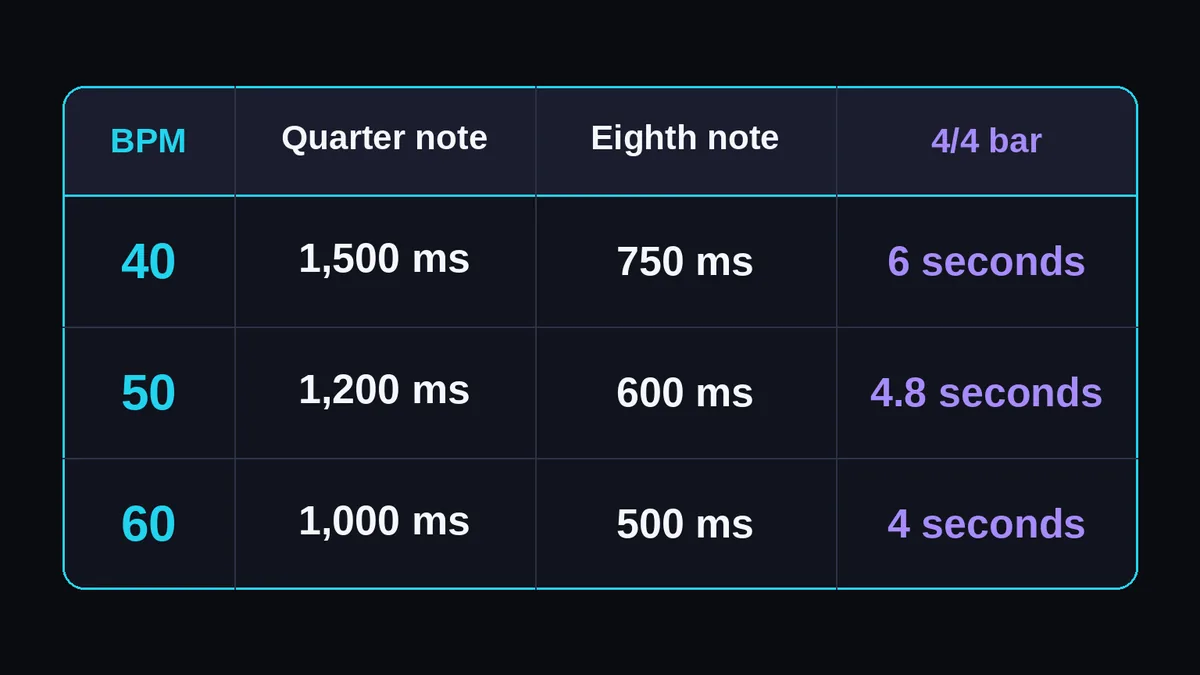
At 50 BPM, a quarter note lasts 1,200 ms, an eighth lasts 600 ms and a sixteenth lasts 300 ms. A 4/4 bar lasts 4.8 seconds at a steady tempo. These calculated durations explain why subdividing can help: you get reference points inside a long beat while keeping the same overall speed.
An eighth is half a quarter; a sixteenth is a quarter of it. Open Music Theory's rhythmic values explains those note relationships.
| Setting | Quarter note | Eighth note | Sixteenth note | One 4/4 bar |
|---|---|---|---|---|
| 40 BPM | 1,500 ms | 750 ms | 375 ms | 6 seconds |
| 50 BPM | 1,200 ms | 600 ms | 300 ms | 4.8 seconds |
| 60 BPM | 1,000 ms | 500 ms | 250 ms | 4 seconds |
The midpoint is (40 + 60) ÷ 2 = 50 BPM, matching Dolmetsch's modern electronic metronome value. This is a preset, not a measured performance average. Check other settings with the note duration calculator.
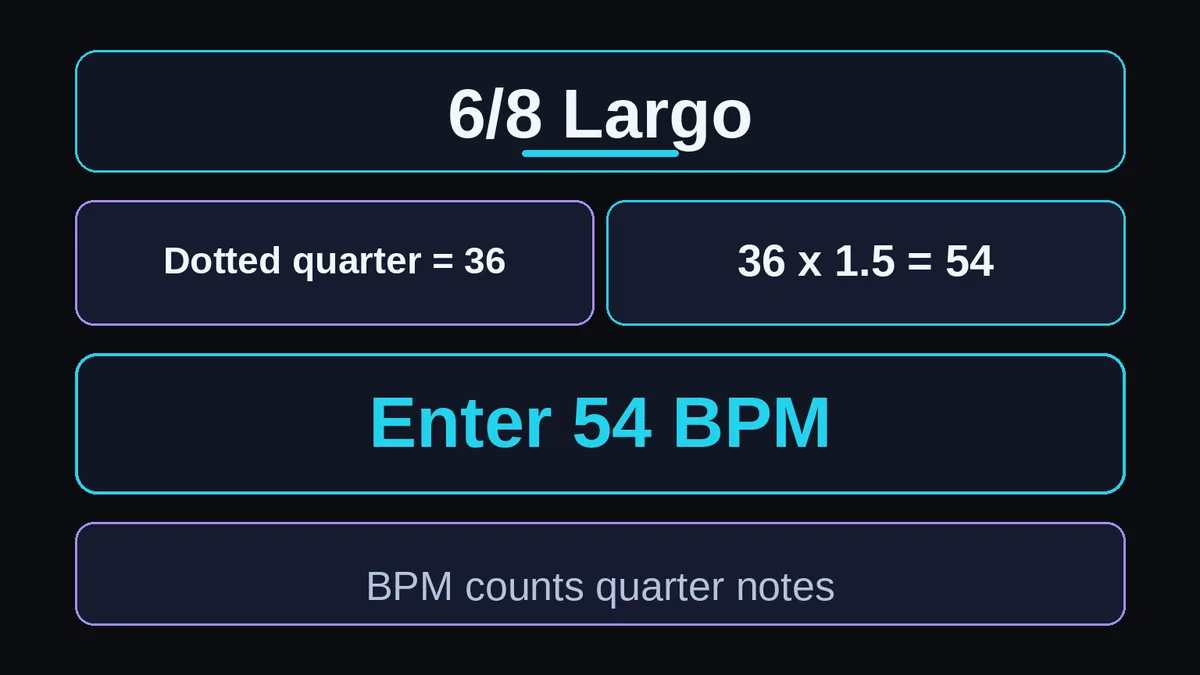
In 6/8, a dotted quarter contains three eighths, or 1.5 quarter notes. A Largo in 6/8 marked dotted quarter equals 36 therefore converts to 36 × 1.5 = 54 quarter notes per minute, inside this site's 40 to 60 band. Choose 6/8 and the normal quarter subdivision setting here: the tool clicks each eighth, three clicks per dotted quarter pulse. See time signatures and BPM before adding further subdivisions.
How Does Largo Compare With Other Slow Markings?
Largo emphasizes breadth; Lento simply means slowly, and Larghetto generally asks for a less slow version of Largo. The numerical bands can meet or overlap. At 50 BPM, this site's Largo and Lento references both apply, so the written word still helps you decide how to phrase the music. Slow marking definitions.
| Marking | Site reference | Character to compare |
|---|---|---|
| Larghissimo | Below 24 BPM | Extremely slow |
| Grave | 20 to 40 BPM | Slow and solemn, with weight |
| Largo | 40 to 60 BPM | Broad, very slow and dignified |
| Lento | 45 to 60 BPM | Slowly, without breadth implied |
| Larghetto | 60 to 66 BPM | A little Largo, generally less slow |
| Adagio | 66 to 76 BPM | Slow and at ease |
Largo sits above the Larghissimo and Grave bands here, overlapping Lento at 45 to 60 BPM and meeting Larghetto at 60 BPM. Keep 50 BPM fixed and compare a sustained phrase with lighter articulation to explore character at one speed.
Which Famous Pieces Use Largo?
Dvořák's “New World” Symphony, Beethoven's Piano Sonata No. 7 and Bach's Concerto for Two Violins supply Largo listening examples. Handel's familiar “Largo” needs a qualification because its aria is marked Larghetto. Compare the actual movement headings before using a recording as a tempo model. Largo examples and Handel's marking.
- Handel, “Ombra mai fu” from Xerxes: “Handel's Largo,” and Arabesque Conservatory's chart example. Its nickname differs from the Larghetto instruction.
- Dvořák, Symphony No. 9 “From the New World,” second movement, Largo: listen for the English horn melody associated with “Goin' Home.” Follow how the solo line continues over the accompaniment. Boston Symphony Orchestra's work guide.
- Beethoven, Piano Sonata No. 7, Op. 10 No. 3, second movement, Largo e mesto: mesto adds sorrow to the broad pace. Try identifying where a quiet passage still needs forward motion. Henle's edition description.
- Bach, Concerto for Two Violins, second movement: MuseCool's example of a lyrical Baroque Largo. Listen to the two solo violin lines and count through one player's sustained note while following the other. MuseCool's Largo glossary.
- Vaughan Williams, Fantasia on a Theme by Thomas Tallis: Classical-Music.com's other Largo example, featuring sustained string sonorities. Listen for how the phrase continues when the texture changes. Published tempo guide.
For the distinction between pace and musical instructions, read what tempo means.
How Do You Practice Largo Without Losing the Beat?
Start at 50 BPM in 4/4 with eighth subdivisions and the beat 1 accent enabled. Count “1 and 2 and 3 and 4 and” through a short phrase, including its rests. Then repeat with quarter note clicks, keeping the subdivisions in your count so sustained notes reach their written endings.
Try this constructed routine, changing settings manually:
- Play four bars at 50 BPM with eighth clicks. Keep the melody's main attacks distinct from your quieter spoken “and” counts.
- Play four bars at 46 BPM. Check the note before each rest: release it on its written boundary, then count through the silence.
- Play four bars at 54 BPM. Keep the same articulation and listen for shortened notes as the click spacing contracts.
- Return to 50 BPM with quarter clicks. If you lose your place, restore eighths for another pass before reducing the support.
At 50 BPM, eighth clicks arrive every 600 ms. Try triplets for passages dividing the beat into three. Use sixteenths briefly to isolate an uneven attack, then restore the subdivision matching the music.
Count bars because this metronome has no practice timer. For early releases, hold a note while counting its complete duration; for late entrances, practice entering after a counted rest. Diagnose the gap before raising the tempo.