
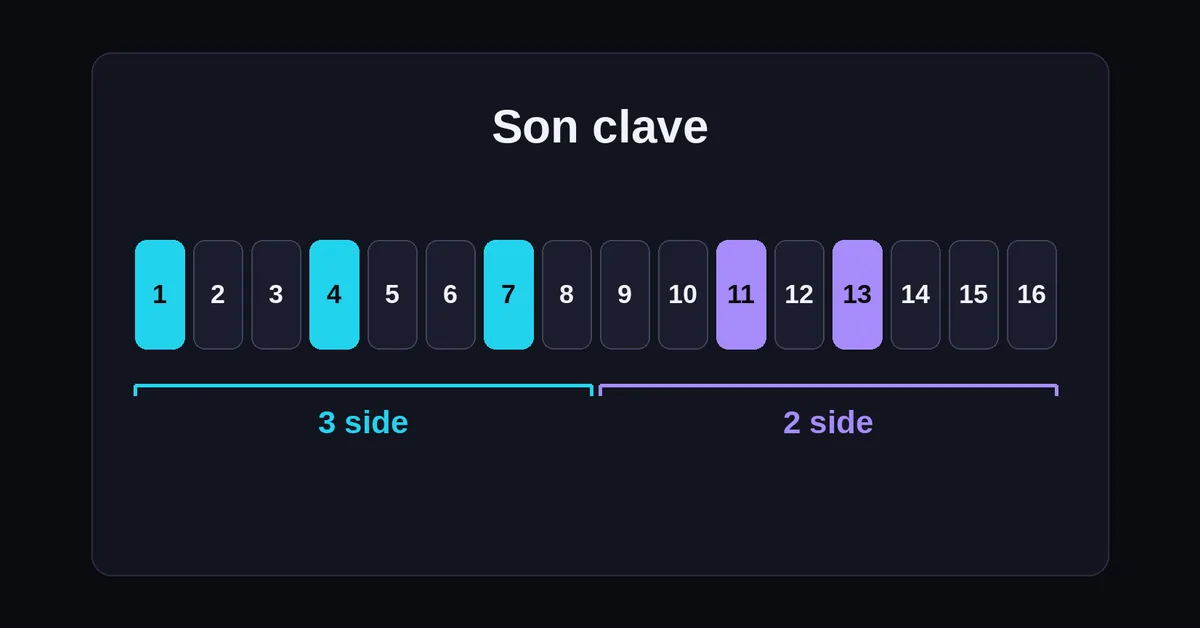
What Is the Clave Rhythm?
Clave is Spanish for key, clef or keystone, and the name fits. Wikipedia describes the five stroke clave as the structural core of many Cuban rhythms: other parts, from the bass to the piano to the percussion, line up their patterns with it.
The rhythm gave its name to the claves, a pair of hardwood sticks struck together. The sticks often play the pattern itself, but the clave also works as an unspoken reference. Even when nobody plays it, experienced musicians feel where it falls and keep their parts "in clave."
Its power comes from asymmetry. One bar is busy and syncopated, the other is calmer and closer to the beat. That push and release, repeated every two bars, creates the forward drive that makes salsa, son and rumba so danceable.
What Is the Difference Between Son Clave and Rumba Clave?
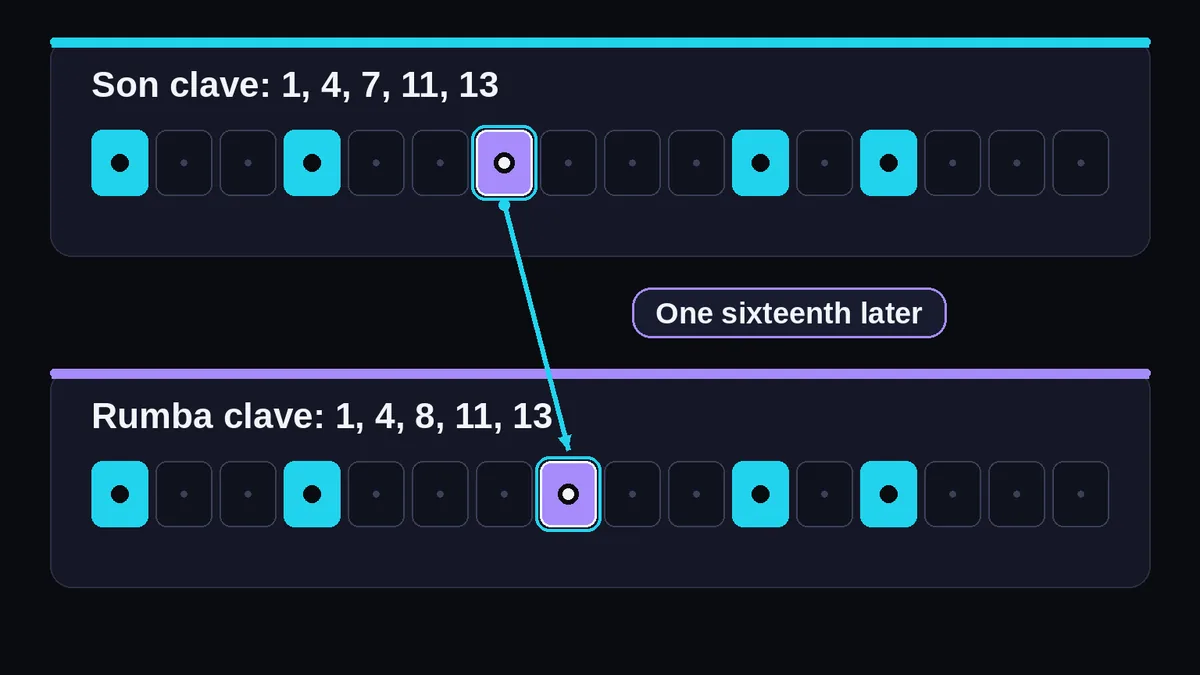
Son clave and rumba clave share four of their five strokes. The difference is the third stroke: in son clave it falls on the "and" of beat 2, while in rumba clave it falls one sixteenth later. That small delay makes rumba clave feel more tense and syncopated.
| Pattern | Strokes in the 3 side (16th count) | Strokes in the 2 side |
|---|---|---|
| Son clave | 1, 1a, 2 and | 3 and, 4 |
| Rumba clave | 1, 1a, 2a | 3 and, 4 |
Wikipedia gives son clave as strokes on 1, 1a, 2 and, 3 and, 4, and rumba clave as 1, 1a, 2a, 3 and, 4, written across one bar of 4/4 in sixteenth notes. Many charts spread the same pattern across two bars of 2/4 or cut time; the shape is identical, only the bar lines move.
Son clave is the one most people know, through salsa and son. Rumba clave belongs to rumba and is also common in some salsa and Latin jazz. Playing the wrong one in a group sounds immediately off to experienced listeners, so it is worth learning both.
What Do 3-2 and 2-3 Clave Mean?
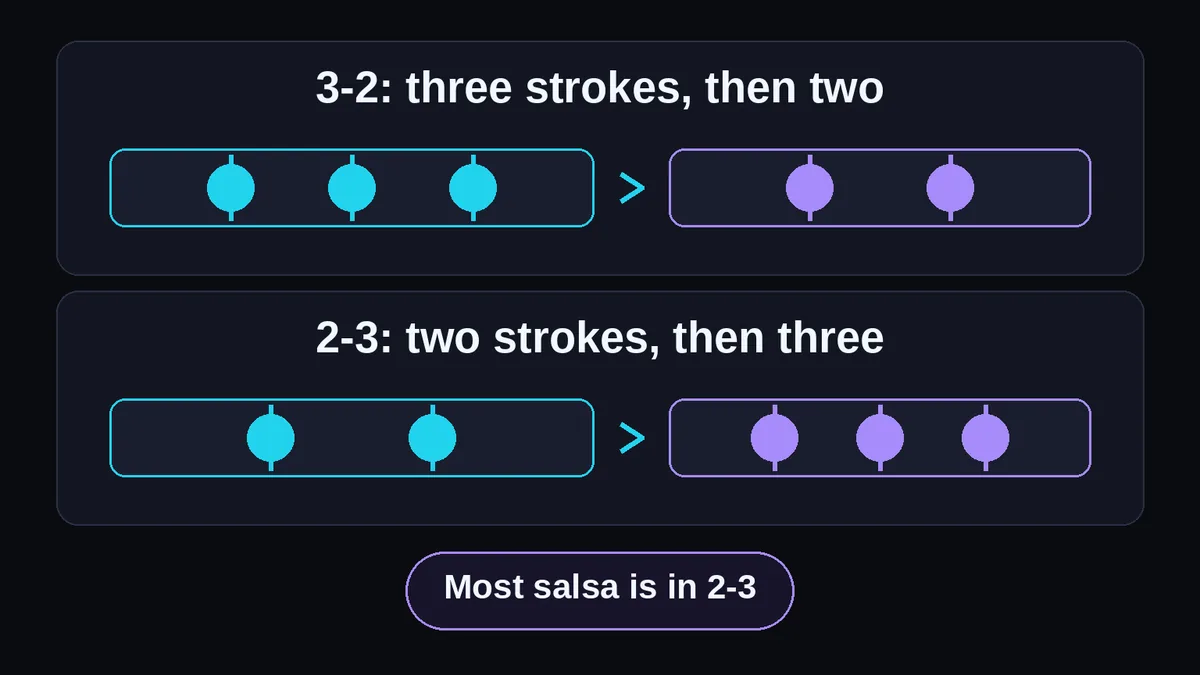
The three stroke half is called the three side and the two stroke half the two side. A song is in 3-2 clave when its phrases start on the three side, and in 2-3 clave when they start on the two side. The pattern is the same; only the starting point changes.
| Direction | First bar | Second bar |
|---|---|---|
| 3-2 | Three strokes | Two strokes |
| 2-3 | Two strokes | Three strokes |
According to Wikipedia, the 3-2 and 2-3 terms came from Mario Bauzá in 1940s New York, and Cuban folkloric musicians do not use that system. It also notes that most salsa is in 2-3 clave. The direction is set by the song's phrases and chord progression, so you choose it by listening to where the melody starts.
How Do You Count the Clave in 4/4?
Count sixteenth notes, "1 e and a 2 e and a 3 e and a 4 e and a," and play on the positions in the table. In a 16 step grid, son clave falls on steps 1, 4, 7, 11 and 13, and rumba clave on 1, 4, 8, 11 and 13.
| Step | 1 | 2 | 3 | 4 | 5 | 6 | 7 | 8 | 9 | 10 | 11 | 12 | 13 | 14 | 15 | 16 |
|---|---|---|---|---|---|---|---|---|---|---|---|---|---|---|---|---|
| Count | 1 | e | and | a | 2 | e | and | a | 3 | e | and | a | 4 | e | and | a |
| Son clave | X | X | X | X | X | |||||||||||
| Rumba clave | X | X | X | X | X |
Start slowly and say the full count out loud while clapping only the X positions. The first three strokes feel uneven, almost limping; that is correct. The last two, on "3 and" and "4," feel more settled. Drum machine and DAW users can program the same grid directly in a 16 step sequencer.
What Is 6/8 or 12/8 Clave?
In music with a triple feel, the clave is played in 12/8, over twelve pulses. Among North American musicians, "6/8 clave" can mean the standard bell pattern, rumba clave or son clave in that triple form, so it pays to ask which one a bandleader means.
| Triple pulse pattern | 12 step grid |
|---|---|
| Son clave in 12/8 | X . X . X . . X . X . . |
| Rumba clave in 12/8 | X . X . . X . X . X . . |
| Standard bell pattern | X . X . X X . X . X . X |
Wikipedia notes that the seven stroke standard bell pattern contains the strokes of both clave patterns, and that the triple pulse son clave is the least common form in Cuban music. For more on how 12/8 works, see the 12/8 time signature guide.
How Does Clave Relate to Tresillo?
The first three strokes of son clave are also known as the tresillo, a rhythm that groups eight pulses as 3 + 3 + 2. Tresillo is the busy three side of the clave on its own, and it appears throughout Latin, Caribbean and popular music, often repeated in every bar.
That connection explains why clave feels familiar even to people who have never heard the word. The tresillo shape turns up in reggaeton, dancehall and many pop songs, while the full clave adds the calmer two side to complete the phrase. Wikipedia also notes that the pattern is known as "hambone" in the United States.
For the BPM of genres built on these rhythms, see the reggaeton BPM guide and Afrobeats BPM guide. For how off beat accents create groove in general, see syncopation.
Where Do You Hear the Clave?
Clave runs through Cuban styles such as son, rumba, mambo, salsa, songo and timba, and through Afro-Cuban jazz. Wikipedia also lists related uses in reggae, reggaeton, dancehall, highlife, soukous and Brazilian styles, showing how widely the pattern has traveled.
In salsa, the clave is the reference for the whole band. The piano montuno, the bass tumbao and the conga pattern are all written to fit it, so a part that is "out of clave" clashes even if every note is in time. That is why salsa players learn clave before anything else.
In Afro-Cuban jazz, the clave meets swing and modern harmony, while in timba and songo drummers build complex patterns around it. Listening for the clave in these styles is one of the best ear training exercises for any rhythm player.
How Do You Practice the Clave With a Metronome?
Set the online metronome to 4/4 with sixteenth note subdivision at a slow tempo, around 70 BPM, so every step of the 16 step grid has a click. Then clap the clave pattern on top, counting aloud, until it feels natural.
- Set 4/4 at 70 BPM with sixteenth note subdivision. Count "1 e and a" with the clicks.
- Clap son clave on steps 1, 4, 7, 11 and 13. Repeat for eight bars.
- Switch to rumba clave by moving the third clap one step later, to step 8.
- Turn the subdivision down to eighth notes, then to quarter notes, so you hold the pattern with fewer guide clicks.
- Practice starting on the two side to feel 2-3 clave, then raise the tempo a few BPM at a time with the speed trainer.
Salsa often runs fast, so many players eventually feel the clave against a half note pulse. Once the pattern is solid at 70 BPM, try it against quarter note clicks at higher tempos and see whether it stays locked.